The UK, UAE and India are becoming increasingly interconnected through investment, trade, technology, real estate and business expansion. For companies operating across these markets, the opportunity is significant. So is the legal complexity.
A business may be incorporated in one jurisdiction, hold investments through another and conduct its core operations in a third. It may have employees across all three, transfer data between them and enter into contracts governed by yet another legal framework.
This creates an important question:
What are the emerging legal risks for businesses operating across the UK, UAE and India?
The challenge is not simply understanding three different legal systems. It is understanding where those systems intersect and ensuring that decisions made in one jurisdiction do not create unintended exposure in another.
Investment Is Becoming More Closely Linked to National Security
Cross-border investment is no longer assessed solely through the traditional lens of ownership, capital and regulatory approval.
Across the India-UAE-UK corridor, foreign investment decisions are increasingly being shaped by national security considerations, particularly where transactions involve sensitive sectors, strategic technologies, critical infrastructure, data or dual-use capabilities. Regulatory screening regimes are evolving across the three markets, reflecting a broader shift towards examining not only who is investing, but also what is being invested in and the strategic implications of that investment.
For investors based in the UK, this can be particularly relevant where capital is deployed into businesses, technologies or infrastructure in India or the UAE. At the same time, Indian and UAE businesses and investment vehicles participating in cross-border transactions may also need to consider the national security and investment screening requirements applicable in the jurisdictions involved.
Why this matters for the corridor
A transaction involving a UK-based investor, a UAE investment vehicle and an Indian technology or infrastructure company may need to be assessed beyond conventional foreign-investment considerations.
The question increasingly becomes:
Could the nature of the business, technology, data or infrastructure make the transaction subject to additional investment screening or national security scrutiny?
For investors, this makes regulatory due diligence part of investment strategy, rather than a final compliance step. Understanding these considerations early can help structure transactions, assess potential restrictions and identify regulatory issues before capital is committed.
Cross-Border Investment Requires More Than Capital
Investment into a new market does not end when funds are transferred.
Businesses and investors may need to consider foreign investment rules, ownership requirements, regulatory approvals, beneficial ownership, AML requirements and ongoing reporting obligations.
The challenge becomes more complex when an investment structure involves multiple jurisdictions.
For example, an Indian operating company may have a UAE holding entity and UK-based investors. Each layer can introduce its own legal and regulatory considerations.
The key is to assess the entire investment structure before the transaction, rather than treating compliance as a post-investment exercise.
Regulatory Compliance Does Not Stop at the Border
One of the biggest risks in cross-border business is assuming that compliance in one country automatically translates into compliance elsewhere.
It does not.
A business may have policies and processes that satisfy the requirements of its home jurisdiction while its overseas operations create additional obligations.
This can affect areas such as:
- Corporate governance
- AML and KYC
- Data protection
- Employment
- Licensing
- Reporting
- International trade
The practical challenge is building a compliance framework that works across jurisdictions while still accounting for local requirements.
When Business Data Moves Across Borders
Data is increasingly one of the most valuable assets businesses carry across jurisdictions.
Customer information, employee records, financial information, intellectual property and R&D data may all move between India, the UAE and the UK.
That raises a broader question:
How do data protection obligations apply when information moves across multiple jurisdictions?
Businesses need to consider where data is collected, where it is processed, who has access to it and where it is stored.
This becomes particularly important for businesses establishing technology or R&D operations across the corridor, where data may routinely move between teams and entities.
CMI & Co’s India–UAE–UK practice specifically highlights cross-border compliance, including data protection requirements such as UK GDPR, India’s Digital Personal Data Protection Act, and the UAE’s data protection framework as part of its advisory offering.
Cross-Border Contracts Need More Than a Governing Law Clause
Contracts sit at the centre of most international business relationships. Yet choosing a governing law is only one part of making a cross-border agreement workable.
Businesses should also consider:
- Where disputes will be resolved
- Whether decisions can be effectively enforced
- How termination will operate
- What happens when regulations change
- How confidential information and IP are protected
- How sanctions or other restrictions may affect performance
A contract designed for a domestic relationship may not adequately address the risks created by a three-jurisdiction business model.
The objective should be to build contracts around the commercial relationship and its cross-border realities, not simply select a familiar legal system.
People and Intellectual Property Move Too
Cross-border expansion is not limited to money and contracts. People, expertise and intellectual property frequently move with the business.
Consider a technology company with:
UK investment → UAE holding structure → Indian R&D team
Who owns the intellectual property developed by that R&D team?
Which employment terms apply?
How is confidential information protected when employees move between entities?
These questions become increasingly relevant as businesses build distributed teams, technology operations and R&D centres across jurisdictions.
For CMI & Co, this intersection brings together its corporate, employment, intellectual property and technology practices rather than treating each issue in isolation. Its corridor practice specifically includes support for businesses establishing operations and R&D teams across the three markets.
Trade and Sanctions Can Create Third-Party Risk
A company operating between India, the UAE and UK may also depend on suppliers, distributors, customers and intermediaries in other countries.
This creates another layer of exposure.
Sanctions, export controls, customs requirements and trade restrictions can affect transactions even when the underlying business relationship appears commercially straightforward.
Businesses therefore need to look beyond their immediate counterparty and understand the wider supply chain.
This is particularly relevant as international trade becomes more fragmented and businesses diversify suppliers and markets. CMI & Co advises on export controls, import regulations, sanctions, customs, trade measures and cross-border trade disputes.
The Risk Is Often in the Gaps Between Jurisdictions
The most difficult cross-border legal issues rarely sit neatly within one practice area.
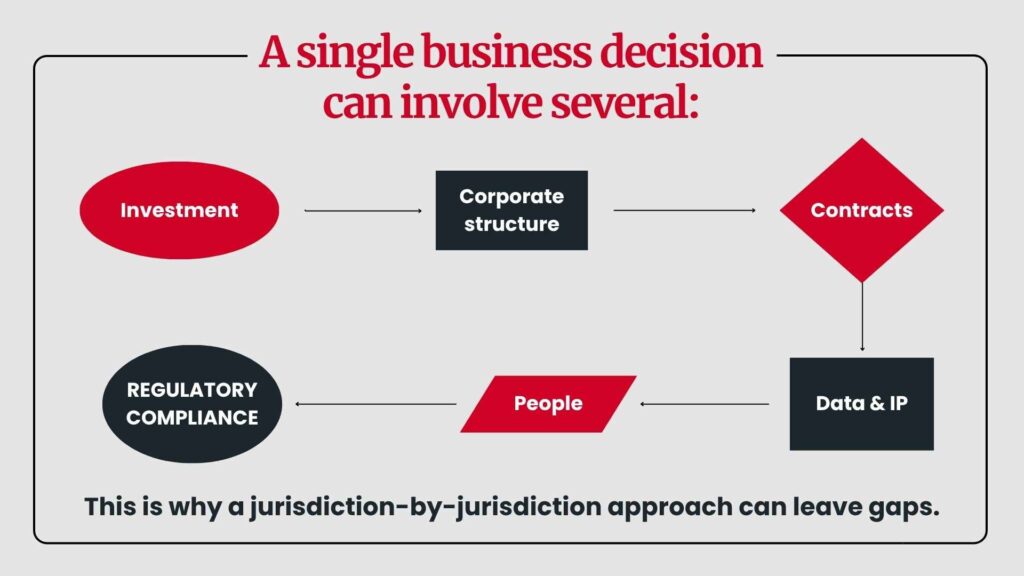
The better approach is to assess how the different parts of the business interact before a transaction, expansion or restructuring takes place.
Conclusion
The UK–UAE–India business corridor presents significant opportunities for companies, investors and entrepreneurs. But successful cross-border expansion requires more than understanding the commercial potential of each market.
The legal risk often lies between jurisdictions: in the ownership structure, movement of capital, transfer of data, employment relationships, contractual obligations and regulatory requirements that connect them.
For businesses operating across the corridor, legal strategy therefore needs to move beyond individual transactions and become part of the wider business strategy.
At CMI & Co, this cross-border approach sits at the intersection of legal, regulatory and business advisory, helping businesses assess, develop and implement strategies for operating across jurisdictions.
Cross-border growth creates opportunity. The right legal framework helps businesses sustain it.